Friday, June 15, 2007
June 2007 - Three Floyds Brewery

Nick Floyd stated that “I’ve had some valuable experiences working at the Florida Brewery and the Weinkeller breweries. The Florida Brewery is a
 regional brewery in Auburndale, Florida that makes adjunct lagers and malta for the US, Caribbean and Central American markets. The Weinkeller breweries where great experience because I got to brew doppelbock, Berliner weisse, hefe weisse, ESB and any style I wanted to in general. The most important thing I learned so far from working at other breweries: You must work for yourself to be happy.”
 The first beer will be Rabbid Rabbit Saison, a 7.4% Belgium Saison. Saison is the name given to pale ales brewed in Wallonia, the French-speaking region of Belgium. Saisons are considered to be farmhouse ale, because Saisons were originally brewed in farmhouses for farm workers who were entitled to up to five liters throughout the workday during harvest season. Saisons are generally bottle conditioned ales, with an average alcohol by volume range of 5 to 8%.
 The 2nd beer that we will be tasting is an American Wheat Beer, Three Floyds Gumballhead. This is beer is 4.8% and is brewed in the traditional American Wheat Style, perhaps the newest style of wheat beer to establish a name for itself. As the profile of American wheat beer is still being carved out, it certainly does not match the profile of a German wheat beer.
 Indeed, American wheat beers are defined by the whims of modern American craft brewers. The barley and wheat malts as well as hops most readily available to American brewers differ from those available to European brewers. Thus, American wheat beers are usually golden to light amber in color with subdued malt character but more assertive hop character that their European counterparts. American-style wheat beers originated in the Pacific Northwest, a region renowned for its affinity for assertively hopped beers. They exhibit more hop bitterness, lacking the roundness of the soft Bavarian wheat beers. The most successful example of an American wheat beer is Widmer Brothers American Original Hefeweizen which, after being available for years only on draft in the Pacific Northwest, was first bottled in 1996 for distribution in selected markets nationwide. Two other well-regarded American wheat beers from the Pacific Northwest are Grant's Weiss Beer and Pyramid Brewing Co.'s Wheaten Ale.
 The next beer from Three Floyds is the Irish Ale, Brain Boru. Ireland's first and last Ard Ri (high king) of the whole Gaelic race, Brian Boru was born in Munster Ireland around 940. His mother was killed by Vikings when he was a child. He spent his life uniting the Irish tribes to become the first king of Ireland, only to be killed at Clontarf on Good Friday, 1014 putting down a rebellion by the King of the province of Leinster. Brian Boru Irish Brand Red Ale is a very rich caramelly ale with toffee, citrus, and pineapple aroma. Brian Boru is brewed with several malts and Amarillo hops.
The term the Brian Boru is used to refer to the Brian Boru harp, the national symbol of the Republic of Ireland which appears on the back of Irish euro currency (ironically, the harp also appears on the Leinster flag, even though Brian Boru was from Munster). Brian Boru's harp is also the symbol of Guinness stout.
The Brian Boru harp, also referred to as the Trinity College harp or simply as the Brian Boru, is the oldest surviving Irish harp. It dates back to the late 14th century and is on permanent display in the Long Room of the library of Trinity College, Dublin The harp was named after Brian Boru, High King of Ireland, but as he died about 400 years before it was made, it cannot actually have belonged to him.

 with 4.8% alcohol. This is Nicks take on a mild American ale with a smooth body and with a bright citrus hops and aroma. Milds are generally brown in color, with emphasis on caramel, chocolate, and roasted malts (they are a close cousin to brown ales and are often considered browns on tap). Generally, they are less bitter than ESBs or other British hoppy ales. Perhaps most importantly, they are low in alcohol--under 5%, often as low as 3%. The mild is thirst-quenching beer--epitomizing the concept of a session beer.
The last beer of the night is Robert The Bruce Scottish ale coming in at 7.2% alcohol. Robert I, King of Scots, usually known in modern English as
 Robert the Bruce, was King of Scotland from 1306 until his death in 1329. Most people know the story of Robert the Bruce from the Academy Award winner for best picture, Bravehart. The portal of Robert the Bruce wasn’t accurate and he wasn’t at the battle dressed as an English knight. Robert the Bruce was made King of Scotland in 1306.

Thursday, February 15, 2007
Febuary 2007 - Doggie Style Beers
 For this month’s Memphis Beer Club we are going with an animal theme, Doggie Style Beers. It was a little difficult to find all of the Flying Dog beers here in
  Now let’s talk about the first beer of the night, Red Dog.
  This retro beer is still brewed by Miller but is marketed through their Ice House Plank Road Brewery. This was one of the most popular domestic beers in the late to mid 1990’s. Red Dog had faded into near obscurity around the turn of the century. In 2005 it was moved into the Plank Road Brewery Family along with Icehouse and South Paw Light. South Paw light is a light version of Red dog with only 110 calories.
The
 The next beer is a Kölsch style beer from Flying Dog Brewery out of
  the first time in 1918 to describe the type of beer that had been brewed by the Sünner brewery since 1906. This type of beer developed from the similar, but cloudier variant Wiess. It never became particularly popular in the first half of the twentieth century, when the most popular beer was bottom-fermented, just as in the rest of
The Flying Dog Brewery open up in 1990 and was the first brewery in


The Raison D Etre from Dogfish Head was the strongest beer of the night, an 8.0%
Dos Perros is a Altbeir brewed by Linus Hall of Yazoo Brewery.I had a chance to meet Linus Hall the brewer/owner of Yazoo Brewery at a tasting here at the Fresh Market in  discussing his beer in great detail I realized that I had made a mistake in rating his beer on RateBeer.com. I tried the Yazoo Flight at the Flying Saucer in
  Cascade hops vs.
Yazoo Brewery owners Lila and Linus Hall are both from
 The Yazoo Brewery is located in what was once the Marathon Motor Works building. From 1910 to 1914, Marathon Motor Works made the first automobiles ever to be produced in the South. About 5,000 cars were made in those five years, earning
 The last beer of the evening was the flagship beer form Flying Dog, Doggie Style Pale Ale. The birth of the American Pale Ale is very interesting. By the late 1970s and early 1980s virtually no true top-fermented ales were being produced in the
The new tradition arose in 
In many ways Sierra Nevada's ale can be taken as the prototype of the new American pale It is an all-malt beer, and the malts are very American (two-row pale, caramel, and dextrin). And significantly, the hop flavor is unabashedly American. In fact they are primarily the signature Cascade hops, citrusy and floral. Of all the American hops, Cascade and her sister varieties are the most obvious stamp of American pale ale, unmistakable in their assault on the palate.
Tuesday, January 30, 2007
January 2007 - Chicago Style

The Memphis Beer Club is going to focus on one my favority cites in the US, Chicago. We are going to sample some of the local Chicago brew from Goose Island and some staple Chicago foods.
Chicago Style Hot Dogs
The style, once known as a "Depression sandwich," is generally acknowledged as having originated at Fluky's, a well-known Maxwell Street stand, in 1929. Chicago-style hot dogs are boiled or steamed to a temperature above 170 degrees Fahrenheit (~77 degrees Celsius) before adding the toppings. They can also be grilled, though these are referred to as "chardogs" in Chicagoland. The natural casing of the hot dogs gives them their distinctive "snap." The most common dog weighs 1/8 lb. and is made with Vienna Beef.
Chicago-style hot dogs with all the toppings are sometimes called "dragged through the garden" because of the unique combination of condiments. Chicagoans traditionally shun ketchup because of the belief that ketchup, unlike other condiments, overwhelms the flavor of the dog itself. The Traditional Chicago-Style Hot Dog is a Vienna® Beef Hot Dog steamed to 170ºF. Nestle it in a steamed poppyseed bun. Pile on the following toppings in this order: this order; Yellow mustard; Bright green relish; Fresh chopped onion; Two tomato wedges; Kosher pickle spear; Two sport peppers ; A dash of celery salt.
Deep-dish Pizza

The Chicago-style "deep-dish" pizza was invented at Pizzeria Uno in Chicago in 1943, reportedly by Uno's founder Ike Sewell, a former University of Texas football star. However, a 1956 article from the Chicago Daily News asserts that Uno's original pizza chef Rudy Malnati developed the recipe
The pizza begins with a simple, thin layer of dough (made with olive oil and often cornmeal) that's laid into a deep round pan and pulled up the sides, then parbaked before the toppings are added to give it greater spring. The crust is lined with meats and/or vegetables such as Italian sausage (a Chicago staple), onions, and bell peppers, either under or mixed with mozzarella cheese. On the usual pizza, about a pound of cheese is used. Then a layer of seasoned crushed tomatoes goes on top and the pizza is baked to completion Besides Uno, famous deep-dish restaurants in Chicago include Uno's companion restaurant Due, which was opened just down the block by Sewell in 1955,Gino's East, Edwardo's, Connie's, Giordano's, Pizano's (which is owned by Rudy Malnati's son, Rudy Jr.), and Lou Malnati's (which was begun by another of Rudy Malnati's sons and is now run by his grandsons and has 23 Chicagoland locations).
Goose Island
Goose Island is the only island on the Chicago River. It is separated from the mainland by the North Branch of the Chicago River on the west and the North Branch Canal on the east. The canal was dug in 1853 by former Chicago mayor William B. Ogden for industrial purposes, thus forming the island. Because he formed the island, at times, it has been known as William B. Ogden Island. After Irish immigrants moved to the island, it took on the name Goose Island as well as Kilgubbin, which was the immigrants' original home in Ireland. The Goose Island Brewery makes Kilgubbin Red Ale, in honor of this name.
 Goose Island was open in 1988 by John Hall and produces several regular and seasonal styles of craft beer, the best-known of which is Honker's Ale. In addition to distributing their beers over 15 states, they also operate two brewpubs in Chicago (in Wrigleyville and Clybourn).
 When the first Goose Island Brewpub opened its doors in 1988, domestic, mass-produced beer was deeply ingrained in Midwestern culture. The craft beer industry was still in its infancy, with only a handful of brewpubs in existence in the Midwest. In his travels across Europe, beer-lover John Hall had enjoyed a distinctive local brew in each region he visited. Hall was convinced that Midwesterners could produce beers as good or better than those he’d tasted in his travels. Living on the shore of the largest system of fresh water on the planet Earth, in a city with rapidly evolving tastes – John decided that his hometown, Chicago, would be the ideal place to do just that.
Today, Goose Island continues to brew an innovative selection of over 50 craft beers at the brewpub, the best of which are then bottled at their Fulton Street brewery. Goose Island is also involved in the production of a small selection of craft sodas. The company currently ships its beers to 13 states and the U.K.

The first beer of the evening will be the flagship brand, Honker Ale English style pale ale. Inspired by visits to English country pubs, Honker’s Ale combines a spicy hop aroma with a rich malt middle to create perfectly balanced ale that is immensely drinkable. A smooth, drinkable English Bitter for those looking for more from their beer.
The next beer was an American Wheat, 312 Urban Wheat. Like the digits suggest, it's a beer that's densely populated with flavor and loaded with character. We don't filter it, so none of its life and soul is stripped away.
The first thing you notice is the hazy, cloudy appearance. That's how you know it's unfiltered. What hits you next is the spicy aroma of Cascade hops, followed by the crispy, fruity ale flavor delivered in a smooth, creamy body, the result of blending barley malt with torrified wheat. It's not like any other Goose Island Beer, but no less than you'd expect.
 To stay with the Chicago theme we had one of the last Bells Oberon from Bells Brewery in Kalamazoo, Michigan. Bells wasn’t happy that their local distributor was bought by one of the Mega-Distributors so the pulled the plug in Illinois. A lot of Chicago’s were very disappointed, but Bells did it on principal.
This was the better of the two American Wheats. An American wheat ale brewed with Saaz hops. Spicy and fruity, Oberon is the color and scent of a summer afternoon. Most drink it with a orange, but I prefer it with out fruit. If you every have a chance to have a Bell’s don’t pass it up.
The Goose Island Nut Brown Ale is brewed in the traditional English style. Nut Brown Ale combines the finest domestic and imported malts to produce a chestnut-hued ale of unusual complexity. Subtle notes of chocolate, honey and fine tobacco give this world champion ale an enjoyable and satisfying "nutty" finish.

The last beer of the evening was the Goose Island India Pale Ale. All of the extra beers where drank before the end of the night. This IPA recalls a time when ales shipped from England to India were highly hopped to preserve their distinct taste during the long journey. The result, quite simply a hop lover's dream. And this classic ale adds a fruity aroma, set off by a dry malt middle, to ensure that the long hop finish is one you'll remember.
Monday, January 29, 2007
December 2006 - Sam Adams Winter Pack
 For this months Memphis Beer club we are going with one of the great "craft" breweries in the United States, Boston Brewery. I'm sure everyone has heard the story about Jim Koch raise to fame brewing his Great-Great father's beer recipe. Boston Lager was introduced on Patriot's Day in 1985. Patriot’s Day was traditionally observed on April 19, in honor of Lexington and Concord, the first battles of the American Revolutionary War. However, like everything else, in 1969 the government moved it to the third Monday in April to provide a 3 day long-weekend. Three months later Sam Adams Boston Lager was named the best beer in the United States at the Great American Beer Festival.
This award was right about the time the "Craft Brewing" was making a come back and by 1995
 there were over 600 craft brewers. That number of has increased every year and is closer to 2,400. In 2006 the Boston Beer Company produced 10 varieties of beer year-round: Boston Lager*, Sam Adams Light, Boston Ale, Pale Ale, Cherry Wheat, Cream Stout, Brown Ale, Hefeweizen, Scotch Ale, Black Lager* and Utopias. It also brews five seasonal beers: Double Bock (Jan - Mar), White Ale (Jan - Mar), Summer Ale (Apr - Aug), Oktoberfest (Aug - Nov) and Winter Lager* (Nov - Jan). In addition Samuel Adams also produces a winter pack that includes Old Fezziwig Ale*, Holiday Porter* and Cranberry Lambic*. (* beers tasted this month). The winner of the 2006 Beer Lover's Choice award is the Honey Porter and will be available in the Brewmaster's Collection in 2007.
In the summer of 2006 Sam Adams releases a Brewer Patriot collection that included four beers that 'Honor the Fine Tradition of American Brewing of our Founding Fathers' which include the Traditional Ginger Honey Ale, James Madison Dark Wheat Ale, George Washington Porter and 1790 Root Beer. I bought three of these Patriot Packs over the holiday and I'm looking forward for the right night for a small tasting.
 Now let’s talk about the beer. We had all had some of these beers from Sam Adams, but never as part of a tasting. Of course we started with the Flagship beer, Sam Adams Boston Lager. The original beer was named after Jim Koch’s Great-Great Grandfather Louis Koch. Jim stated that “I renamed my beer after the patriot Samuel Adams, who helped lead the American Revolution and was a brewer by trade. (All pub owners were breweries back in the 1700’s)I thought the name was assertively American”
As always this beer delivered on taste. Is has a very full bodied and
 complex malt flavor and a deep golden amber color. The malt flavor is slightly on the sweet side, but the Nobel dried hops give it a rich floral and piney aroma. The beer poured smoothly with a nice lasting 2” head. I had forgotten how much I like this beer and it’s no wonder why this beer is everywhere and should be enjoyed more often.
 Next we sampled the Sam Adams Winter Lager. As all winter Lager these is a rich warm malty beer. By increasing the malts per liter brewer’s pushed up the potency of this brew to warm up a beer drinker’s soul. Winter Lager is a Weizenbock that was invented in Germany and brewed for religious holidays. Bocks were primary brewed by Germen monks to provide essential nutrients for the long fasting period during lent.
Sam Adams Winter Lager was the company’s first seasonal offering as it still one of its best sellers. Because it is a Weizenbock it is brewed using generous quantities of malted wheat. This gives it a crisp finish that is different from traditional bocks. Like the Boston lager it has a rich malty flavor and beep brown to amber color. The hint of orange peel paired with the roasty sweetness of
 the malts makes this a beer that is well balanced and warms up your insides on a cold night, or day.
The Samuel Adams Black Lager is a great example of a Schwarzbier. We first had a ‘Black Lager’ almost a year ago at the South of the Border tasting with Xingu. Xingu stated that the oldest reference to a ‘Black Lager’ dated to the Amazon region in the 1550’s. However there are references to a “Brunswick Mum” in the 1390’s in Germany. Even thought most of these beers are extremely dark in color they are a distant cousin of Porters and Stouts.
 Porters and Stouts are highly hopped ales that were invented in Britain, Schwarzbier is lightly hopped and is fermented using a bottom fermenting lager yeast. The roasting of several malts is what gives this smooth malty beer its deep black color. Sam Adams Black lager uses this bottom fermenting traditional method to produces is Schwarzbier. I’m only able to pick up the Black Lager in the Brewmaster’s 6 pack, but it is worth it for this beer. This beer is a deep ruby black with a sweet malty flavor. Due to the limited amount of hops this dark beer has a nice dry finish.
 We have tried a lot of different beers the last few months and this is the
 worst beer we have tried hands down. I thought Steel Reserve would win the title, but the Sam Adams Cranberry Lambic is the Grand Champion. I know Sam Adams states that it’s not a Belgium style lambic, but why make such a bad beer instead. The tag line from Same Adams is “Tart and sweet, with complex fruit and vanilla notes.” It should be “Another fruity beer that taste like ass”
This style of beer is named for the Lambic region in Belgium where it was originally developed. Lambics are wheat beers that are traditionally brewed using native fruits and an open fermentation, a process where the unfermented wort is left in an open vessel in the brewhouse and is fermented by the wild yeast in the air - this process lends the beer its uniquely fruity fermentation character. That night was going so well until this beer.
 The Sam Adams Holiday Porter is a good example of a British Style porter. They use a combination of five malted barley in the brewing process. The use of Carafa malts gives this porter a smooth roasted malty character. Like the traditional British style a generous portion of English hops, East Kent & Fuggles, gives this beer a great hop aroma and finish.
In 1802, a writer named John Feltham wrote a version of the history of porter that has been repeated hundreds of times since. Unfortunately, very little of Feltham's story is backed up by contemporary evidence. His account is based upon a letter written by Obadiah Poundage (who had worked for decades in the London brewing trade) in the 1760´s. Unfortunately, Feltham badly misinterpreted parts of the text, mainly due to his unfamiliarity with 18th century brewing terminology. Feltham claimed that in 18th century London a popular beverage called "three threads" was made consisting of a third of a pint each of ale, beer and two penny . About 1730, Feltham said, a brewer called Harwood made a single beer called Entire which recreated the flavor of "three threads", and which became known as "porter". It took its name from its popularity with the thousands of street and river porters (but not market porters) of London, who drank it to refresh themselves as they carried goods and parcels off and on ships in the Thames and around the streets of England's capital.
Sam Adams Holiday Porter deep rubbish black porter that was first introduced in the Sam Adams Classic Winter pack in 2204. This Holiday Porter is a smooth porter which combines a roasted malty start with a nice dry hop finish.

 The last beer of the evening was the Old Fezziwig Ale, a spiced winter beer. This is another rich malty beer from Sam Adams’s Winter Pack with a big spice finish. Sam Adams state that this is the “Big Christmas Cookie” of beers, but I disagree. I was not looking forward to this beer after reading that is has a spiced flavor of cinnamon, ginger and orange peel, but once again I was pleasantly surprised.
Friday, December 08, 2006
November 2006 - Thanksgiving
Thanks for a great 2006 and I look forward to seeing everyone in December.
Thursday, October 26, 2006
October 2006 - Oktoberfest
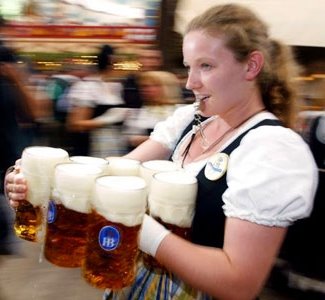
It is time again to celebrate the joys of beer, food and friends. Lot’s of US brewers are now making Oktoberfest beers, but we decided to go with traditional Germany beers we can get here in Memphis. Oktoberfest is a two-week festival held each year in Munich, Bavaria, Germany during late September and early October. It is one of the most famous events in the city and the world's largest fair, with some six million people attending every year.
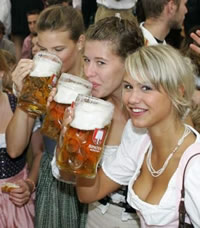
The event usually takes place during the 16 days up to and including the first Sunday in October, but if this day is the 1st or 2nd then the festival will go on until the October 3rd (German Unity Day). Thus, the festival is 17 days when the 1st Sunday is October 2nd and 18 days when it is October 1st. The festival is held on an area named the Theresienwiese (Field [or meadow] of Therese), often called “d’ Wiesn” for short. Beer plays a central role in the fair, with every festival beginning with a keg of beer tapped by the Mayor of Munich who declares “O'zapft is!” (Bavarian: “It’s tapped!”). A special Oktoberfest beer is brewed for the occasion, which is slightly darker and stronger, in both taste and alcohol. It is served in a one-liter-tankard called Maß. The first mass is served to the Bavarian Minister-President. Only local Munich breweries are allowed to serve this beer in a Bierzelt, a beer tent which is large enough for thousands.
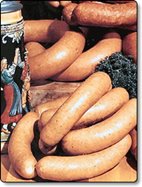 Visitors also consume large quantities of food, most of it traditional hearty fare such as sausage, hendl (chicken), käsespätzle (cheese noodles), and sauerkraut, along with such Bavarian delicacies as roast ox tails. In the year 1880, the city government approved the sale of beer. The electric light illuminated over 400 booths and tents. In 1881, booths selling bratwursts opened. In 1892, beer was first served in glass mugs. There are many problems every year with young people, who overestimate their ability to handle large amounts of alcohol. Many pass out due to drunkenness. These especially drunk patrons are often called "Bierleichen" (German for "beercorpses").The six Oktoberfest breweries, (Spaten, Augustiner, Paulaner, Hacker-Pschorr, Hofbräu, Löwenbräu) sold 6 million mugs of beer in 2005 (5.5 million in 2004).
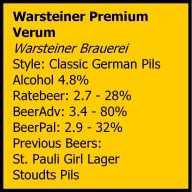
One of my fondest drinking memories was deciding to spend my last five dollars at the Germaina Oktoberfest on just ONE more mug of Warsteiner rather than eating a currywurst. Looking back of should of had the currywurst. Warsteiner Premium Verum is an example of a Classic German Pilsner brewed by Warsteiner Brauerei of Arnsberger Forestpark, Germany. The Warsteiner Brewery lies deep in the heart of the Arnsberger Forestpark (Arnesberg Forest Nature Park) outside of Warstein, Germany in the north central section of the country. The Cramer family has been brewing beer since 1753 with Warsteiner Premium Verum begin the #1 selling beer in Germany.
The invention of modern refrigeration by Carl von Linde removed the need for caves in which to store the beer, however even until recently the Pilsner Urquell brewery still fermented their beer using open barrels in the cellars underneath their brewery. This technology was changed in
 1993 since large cylindrical tanks are used, however small samples are still brewed in a traditional way for the comparison of the taste. They also have the unique claim to being "the world's first golden beer."
A modern pilsener has a very light, clear color from pale to golden yellow, and a distinct hop aroma and flavor. Czech pilseners tend toward a lighter flavor with good examples being Pilsner Urquell and Staropramen, while those in a German style can be more bitter (particularly in the north, e.g. Jever) or even "earthy" in flavor. Distinctive examples of German pilseners are Flensburger, Beck's, Konig, Radeberger, Veltins, Fürstenberg and Wernesgrüner.
Next we will be drinking a beer brewed by Paulaner Brauerei brewery in Munich Germany, Paulaner Hefeweissbier. Paulaner is a German brewery, established in the early 1600s in Munich by the monks of the Neudeck ob der Au monastery. The monastic order and the brewery are named after Saint Paul.
Belgian witbieren (“white beers") are based on the best-known example, Hoegaarden Wit. Such beers get their name from the suspended wheat proteins which give it a whitish color. Belgian white beers often have spices such as coriander or bitter orange peel added, giving them a slightly fruity flavor. They are also often made with raw unmalted wheat, as opposed to the malted wheat used in other varieties.

German wheat beers are a well-known variant throughout the southern part of the country, the name changing from Weizen in the western (Swabian) regions to Weißbier or Weiße in Bavaria. Hefeweizen (German for "yeast wheat") is a variety in which the yeast is not filtered out, though Kristallweizen (filtered), Dunkelweizen (dark) and Weizenbock (higher alcohol content) varieties are also available. The filtration which takes the yeast out of Kristallweizen also strips the wheat proteins which make Hefeweizen cloudy. Bavarian weizen beers are fermented with a special strain of top-fermenting yeast, Torulaspora delbrueckii, which is largely responsible for the distinctive flavor. This is the Paulaner brewery's number one best seller. It's natural taste as well as the many vitamins, minerals and micro elements remain, due to the unfiltered method of brewing.
 The next beer is Spaten Premium Lager, brewed by Spaten-Lowenbrau (InBev) in Munich, Germany. The first time the Munich tax registry lists a brewery in the building is in 1397. It was first opened by Hans Weiser and changed many times until 1522. The Stamberger family ran the brewery from 1522 to 1622 until the Spaten family purchased it in 1622. The Spaten family only ran the business for about 70 years until the Siessmayr family purchased it in 1704.
In 1807 Gabriel Sedlmayr the Younger, the master brewer to the royal court of Bavaria at the time, purchased the smallest brewery at that time. The modern method of producing lagers was pioneered by Gabriel, who perfected the dark brown lagers that made Spaten famous. After the death of their father, Gabriel, sons Gabriel and Joseph take charge of
 the brewery until 1842. In 1842 Joseph leaves Spaten to purchase the Leist Brewery and buys out the Franziskaner brewery in 1861.
In 1867 Spaten is now the largest brewery in Munich and is the only German brewery to receive a gold medal at the Paris World Exhibition. That is followed by creation of the first Oktoberfest beer in 1872. Johann, Carl and Anton assume control of the brewery in 1874 and work with the artist Otto Hupp to design the logo that is still used today. In 1922 The Spaten and Franziskaner-Leist breweries merge. Thus bring to gather the two Sedlmayr families.
We will be breaking away from the German beers to try a
 Spice/Herb/Vegetable beer from the Dogfish Head Brewery, Punkin Ale. Dogfish Head's signature product is its line of India Pale Ales (IPAs), which are offered in three varieties: 60 Minute, 90 Minute, and 120 Minute IPA. Their names refer to the length of the boil time of the wort in which the hops are continuously added. The 60 Minute is described by the company as "A session IPA brewed with Warrior, Amarillo and Mystery Hop X." To further enhance the hop flavor of their 90 Minute IPA and 120 Minute IPA, Dogfish Head introduced a device in 2003 jokingly called Randall the Enamel Animal, an "organoleptic hop transducer module" which "Randallizes" either Dogfish Head 90 Minute or Dogfish Head 120 Minute IPA by passing the beer through a large plastic tube filled with raw Cascade hops. The alcohol in the beer lifts oils off the raw hops and imparts even more hop flavor to beers that were already hoppy to begin with.
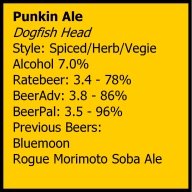 Fruits have been used as a beer adjunct or flavoring for centuries, especially with Belgian lambic styles. Cherry, raspberry, and peach are a common addition to this style of beer. Modern breweries may add only flavored extracts to the finished product, rather than actually fermenting the fruit. New Glarus Brewing Company of Wisconsin produces Raspberry Tart, a framboise made with raspberries, wheat and year old Hallertau hops, and fermented in large oak vats. Pumpkin flavored beers are brewed seasonally in the autumn in North America. An example is produced by Coors Brewing Company's Blue Moon brand. .Dogfish Head Punkin Ale is a full-bodied brown ale brewed with real pumpkin, brown sugar, allspice, cinnamon & nutmeg."
Now back to the Oktoberfest. Warsteiner Dunkel brewed by Warsteiner
 Brauerei of Arnsberger Forestpark, Germany. Dunkel, along with helles, is a traditional style brewed in Munich and popular throughout Bavaria. With alcohol concentrations of 4.5% to 6% by volume, dunkels are less strong than doppelbocks, another traditional dark Bavarian lager. Friends of Warsteiner are welcomed to tour the brewery at Waldpark and see for themselves the high technical standards throughout the production process. From quality control on arrival of the raw materials, to the brewing process in the brew-house, the fermentation cellar, and during bottling on highly advanced bottling lines. No tour is complete without a beer tasting in the cozy, rustic atmosphere of our Waldfrieden guest house, where guests can treat themselves to a freshly drawn Warsteiner served in a elegant glass mug, a present to visitors as a souvenir after an entertaining and instructive day devoted to beer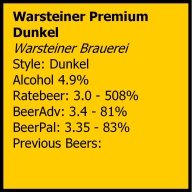
Warsteiner Premium Dunkel, "German for Dark" offers beer lovers incomparable taste satisfaction with its subtle spiciness, delicate aroma, and balance. What makes premium Dunkel distinctive among dark beers is its thirst quenching, refreshingly drinkable flavor. Warsteiner Premium Dunkel is a traditional German dark brown lager. In Germany, they would refer to this style of beer as, "Dunkel". Warsteiner Premium Dunkel is described as being neither sweet nor roastily dry, with a slight spicy maltiness and a clean round finish. It has a reddish-black color which is almost opaque.

The last beer of the night is the Paulaner Salvator, a Doppelbock. The name of the Paulaner brewery refers back order of monks of San Francesco di Paola, who resided in Neuhauser Straße in Munich. The monks had brewed beer for their own use since 1634. The beer that was permitted to be sold on holidays was a Bock style which gained local fame. Franz Xaver Zacherl, the brewer, purchased the former cloister brewery and continued the "Starkbier" tradition with the product Salvator, which is Latin for "Saviour". In 1861 the "Salvatorkeller" (Salvator cellar) was opened upon Nockherberg. In 1928 the brewery merged with the Gebrüder Thomas brewery creating Paulaner Salvator Thomas Bräu. 1994 saw the acquisition into the Kulmbacher brewery group with the affiliated producers Plauen and Chemnitz.
 Paulaner Salvator was served by the monks as a replacement for food at Lent. Their most famous brewer was Brother Barnabas, who was the head of the Paulaner monastery brewery starting from 1773. Its original recipe is today almost the same as it was in Barnabas' time. In order to protect the original recipe, Paulaner had the trade mark "Salvator" patented in 1896.